If you’re experiencing jaw pain, clicking on opening or closing, clenching or grinding your teeth (day or night), this is for you!
Jaw trouble is incredibly common in adults and kids and there are a whole variety of different triggers that can be related to why this is happening and why it isn’t going away on its own.
So much so, often you have to address more than one factor in order to get on top of the pain, discomfort, noises or clenching in order to see a positive result.
Firstly, let’s talk more about the jaw joint itself.
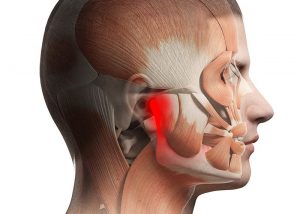
Jaw pain is pain felt at the temporomandibular joint, just in front of the ear.
It is a hinge like joint, with two key motions required on opening and closing, firstly a rotation, followed by a gliding motion.
There are 4 muscles that cross the joint, the temporalis, masseter and medial and lateral pterygoids.
These are involved in opening and closing the mouth, as well as side to side actions.
So every time you move your jaw, you are activating one or all of these to get it to move.
In addition, there is a disc inside the joint that sometimes can get caught or squashed, as well as a muscle attachment that runs through part of the joint.
Common Aggravators
The jaw can be irritated by many different factors including:
- Chewing, particularly on hard, crunchy or chewy things
- Yawning
- Coughing
- Talking
- Laughing
- Mouth breathing
- Smiling
- Positional factors (facial habits, such as postures you pull without realising you’re doing it)
- And lastly stress
Common Symptoms
There are lots of different symptoms that you may experience with jaw / TMJ issues and you don’t necessarily have to have all of them in order to be diagnosed with a TMJ condition including:
- Aching, pulling, tightness around the jaw, ear, or outside of the skull (temporal area)
- Clicking, crunching, grinding, popping sounds which may occur on opening or closing, on one side or both
- Redness around the area
- Swelling
- Clenching or sore teeth in the morning
Common Causes of Jaw Pain
Common factors relating to jaw pain include:
- Tight muscles in your cheek, neck, or head.
- Stress.
- Grinding or clenching teeth long dental or surgical procedures where the mouth must be kept open.
- Altered jaw position for example after braces, related to dentures, implants or mouth guards.
- Other factors such as genetics, arthritis, overuse or trauma are also important factors to be considered.
How do I know it is jaw pain and not something else?
It is commonly diagnosed by physical examination performed by a healthcare professional, such as an Osteopath or Dentist.
What can we do together?
Your Osteopath will work with you to firstly formulate a diagnosis, as well as identify any other factors that may be contributing to your symptoms, then come up with a plan to ease the discomfort.
This may include hands-on treatment, as well as exercise aimed to normalise your movement patterns and strengthen the surrounding areas.
How can you help yourself?
1. Self massage the face
Using flat fingertips, massage your cheeks and temporal area, slowly and gently in a circular motion to ease muscular tension. Start with 30 seconds – 1 minute, 2-3x per day.
2. Slow opening and closing of the mouth
This is best done in front of a mirror. As slowly as you can, open your mouth and watch your movement. Look for your jaw deviating to one side, such as a circular or even an s shaped movement (where your jaw moves to one side and then the other). Then watch on closing the mouth. Practice controlling the movement to make it as smooth and even as you can to retrain the tissues. Perform 5 open and closing movements, 2-3x per day.
3. Relaxation techniques
Enjoy some relaxation to reduce nervous tension leading to muscle tightness. Gentle stretching of the whole body, breathing exercises, meditation or even getting outside for a walk can all be beneficial.
4. Try heat or cold
You could use a warm pack or something cool to provide temporary pain relief. Unless there is visible signs of swelling, heat is more likely to be beneficial.
6. Dietary changes
The physical act of chewing can aggravate a sore jaw, short term reduction of crunchy or chewy foods may be useful.
7. Reduce the chatter
Talking uses a lot of muscles, including those that cross the jaw. A little more quiet time may ease the pain, but not talking is so hard for some people, so definitely put this one through your own filter.
If all of this isn’t enough, or you want to save time and get on top of things quickly.
8. See a professional
Our Osteopaths have loads of experience treating jaw pain, clicking, grinding, clenching, tension headaches and so much more. Alternatively, if you think it’s because you have something wrong with your teeth, make an appointment with your dentist.
Recovery
Sometimes long-standing pain can take a while to resolve.
We expect your jaw pain to resolve in 4-6 weeks, however, this can vary depending on the causes of your pain.
If we believe your pain is related specifically to dental issues, we will also recommend that you see your dentist for further evaluation.
In some instances, temporary mouth guards or other devices may be recommended, to protect your teeth from damage when associated with grinding, or other devices to reduce pain or discomfort.
We will often prescribe you specific exercises or advice specific to your particular presentation and does not apply to everyone, which is why we haven’t included more information here.
If you would like more information about jaw pain and what to do about it, please don’t hesitate to contact our team at any time.